
The Nipple as Hardware: What Chappell Roan's Grammy Dress Reveals About Body Politics
When camp provocation meets naturist principles. (Also: https://blog.berrimansbareall.uk/p/the-nipple-as-hardware/)


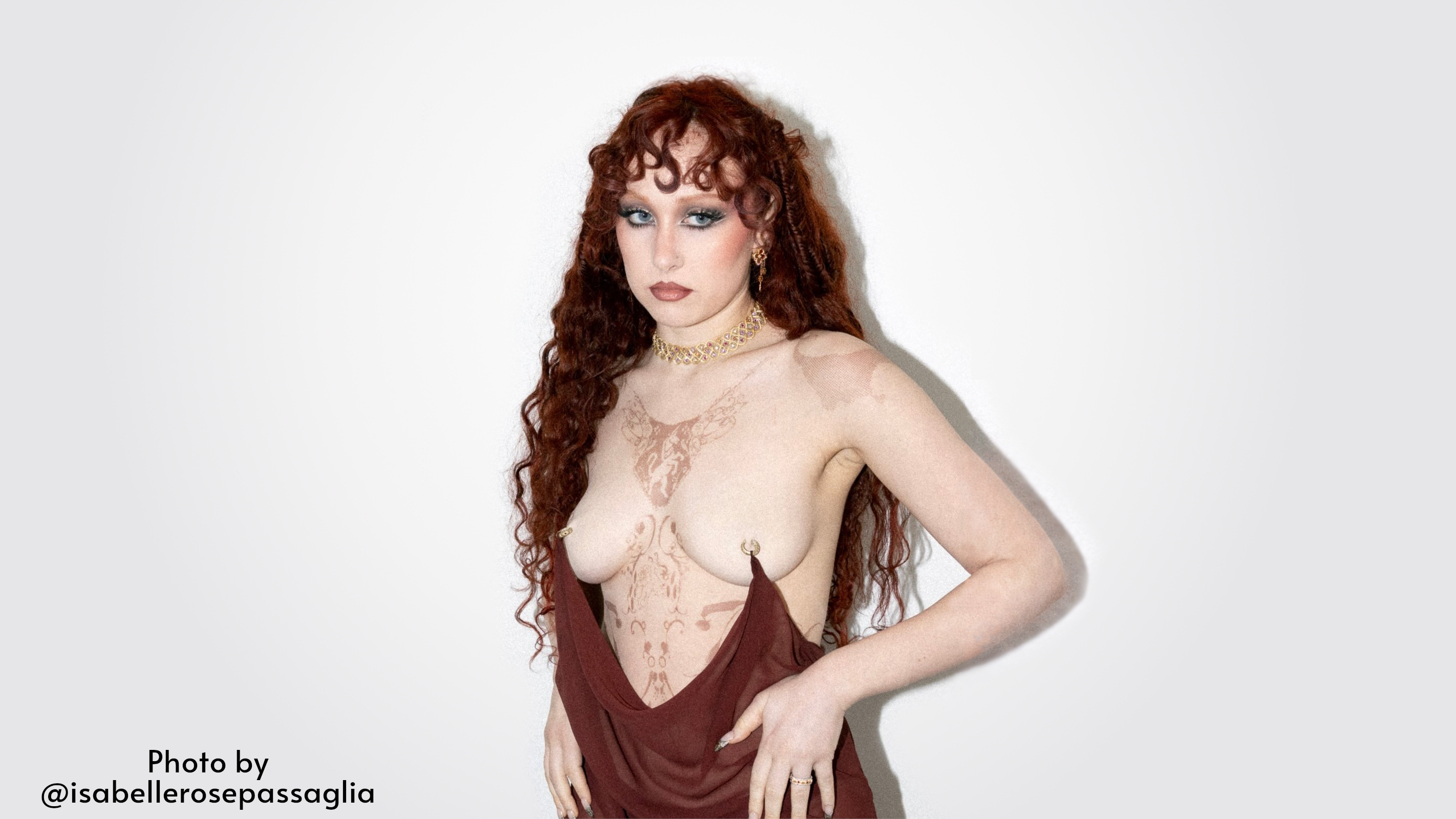
When Chappell Roan swept onto the 2026 Grammy Awards red carpet in a sheer burgundy Mugler gown that appeared to hang from nipple piercings, the internet divided itself into familiar camps. Some called it “disgusting” and “low class”. Others praised it as “daring” and “imaginative”. Chappell herself responded: “Giggling because I don’t even think this is THAT outrageous of an outfit.”
But from a naturist perspective, the conversation revealed something more interesting than whether the dress was shocking. It exposed fundamental questions about how we challenge body shame, who controls narratives about female bodies, and whether spectacle and normalisation might be different paths toward the same destination. When millions are suddenly discussing nipple taboos and platform censorship, there’s an attention window; the question is whether naturist advocates are positioned to seize it.
Two Feminist Approaches to the Male Gaze
At their core, camp provocation and naturist philosophy both represent feminist responses to patriarchal control over female bodies. But they operate from opposite directions.
Chappell Roan’s approach, rooted in the drag-inspired camp culture and queer performance art she is known for, weaponises the spectacle. It says “I will control how shocking my body is. I decide what to do with it. My presentation is my power.” This is individualist bodily autonomy through dramatic visibility. The body becomes a theatrical canvas, art object, provocation. RuPaul’s Drag Race epitomises this philosophy; queens compete for fiercest presentation, judges critique looks, and spectacular embodiment is celebrated as radical self-expression.
Helen’s naturist feminism operates from a fundamentally different premise. When she appears nude on television, she’s not making spectacle—she’s refusing sexualisation. She’s saying “My body is not inherently sexual. It simply exists. Your gaze doesn’t define it.” This is collective body acceptance through casual normalisation. The body is naturalised rather than weaponised, de-emphasised rather than showcased.
Both challenge patriarchal control. Both assert women’s rights to define their own bodies. But one says “look how outrageous I can be” whilst the other says “there’s nothing outrageous here at all.”
Importantly, however, neither approach is wrong. They’re addressing different aspects of the same problem, that being a culture that simultaneously obsesses over and condemns female bodies, that demands women’s bodies be available for viewing whilst punishing them for visibility.
What the Dress Actually Does
The custom Mugler creation by creative director Miguel Castro Freitas referenced Manfred Thierry Mugler’s legendary Spring/Summer 1998 “Jeu de Paume” Haute Couture collection. Silver rings attached to prosthetic nipple pasties appeared to suspend sheer maroon chiffon from Roan’s chest. The prosthetics were smooth and nipple-less, creating what makeup artist Andrew Dahling described as a “Barbie-like illusion” and “a Mugler medieval fantasy for the carpet”. The original 1998 version, worn by Belgian model Erica Vanbriel, used her actual nipple piercings to support the fabric weight.
But there’s a crucial detail that most commentary missed; it was all an illusion. SFX artist Sasha Glasser revealed that during testing, the silver rings ripped straight through the silicone prosthetics under any tension. Even after reinforcing each prosthetic with power mesh — durable fabric typically used in athletic wear — the rings could not bear the fabric’s weight. The actual structural support came from a skin-tone mesh bodysuit worn underneath, designed to blend invisibly into Roan’s skin whilst anchoring the draped chiffon. The nipple rings were purely decorative. They held nothing up.
This transforms the analysis. From a naturist perspective, we initially read the engineering as problematic but at least pragmatic — biology teaches us that bodies do have a structural reality, and breasts have mass and position to varying degrees. Using them as anchor points isn’t inherently sexual, it’s functional, much like how the Ta-Ta Towel uses underbust support to stay attached. But the dress wasn’t actually using breasts as anchor points. It was performing the idea of it whilst a hidden layer did all the real work. Where Vanbriel’s 1998 original genuinely employed her body’s structure, Roan’s 2026 version simulated that relationship for spectacle alone.
The dress made decorative hardware of a non-functional attachment point, inviting millions of viewers to examine her breasts closely to understand a suspension mechanism that didn’t exist. It fragments the body into components rather than presenting a whole person — the opposite of naturist photography ethics, which emphasise whole-person presentation in context. The only purpose of drawing the eye to her chest was theatrical.
But this is where it gets interesting; the dress also exposed an absurdity.
The Prosthetic Paradox
None of what viewers saw was real. Not the nipples, not the piercings, and — as we’ve seen — not even the structural engineering. Three layers of illusion, each distancing the dress further from anything resembling an honest relationship with the body beneath it.
Social media platforms allowed the images to circulate because no actual female-presenting nipples were visible. Roan could show her complete breast’s form — movement, sides, underboob, everything … except that final five per cent of her breast anatomy.
This highlights an uncomfortable cultural truth. We’ve decided breasts are mostly acceptable but female nipples are uniquely shameful. Different platforms apply different rules; some permit nipples in art or protest contexts, others in breastfeeding, most ban them outright. But the underlying pattern remains consistent; it’s the nipple itself that is treated as the problematic element. The prosthetic approach technically complies with platform algorithms whilst exposing how gymnastically absurd those rules are. After all, male nipples are allowed and the female nipple looks remarkably like the male one, only a little larger.
From a naturist perspective, showing actual nipples would be far more honest. The prosthetic approach reinforces that nipples specifically are “the problem,” validates censorship algorithms, and makes concealment itself the story. When you hide only the nipple whilst showing everything else you’re not challenging body taboos, you’re accepting them whilst finding a technical loophole.
But strategically, the prosthetic approach did something useful; it brought these absurdities to the attention of millions. The conversation became “why are only the nipples forbidden whilst everything else is permitted to be shown?” That’s exactly the question naturist advocates want people asking, though perhaps not in the way everyone else was asking it.
The “TV Friendly” Capitulation
This became clearer when Roan changed into her second dress to present the Best New Artist Award during the broadcast ceremony. Inspired by classically wrapped fabric, the second dress again covered her nipples whilst showing almost complete breast form, sides, and movement. However, this one was deemed “TV friendly.”
The irony deepens once you know about the mesh bodysuit. Both dresses were fully supported garments with hidden structural layers. Both covered the nipples. The functional difference was almost entirely cosmetic — the presence or absence of decorative silver rings on prosthetic areolas. Yet one was deemed too risqué for broadcast and the other acceptable.
American broadcast standards are remarkably vague on this point. The FCC only prohibits material that, in the context of the broadcast, depicts “sexual or excretory organs or activities in a way that is patently offensive.” That’s it. The guidelines are deliberately subjective, offering no specific definitions of what constitutes “patently offensive” depiction. In practice, this vagueness doesn’t produce liberal interpretation — it produces terror. Networks self-censor far beyond what the regulations actually require, because the penalties for misjudging the FCC’s subjective standards are severe and the safe option is always more coverage. So for the context of the Grammy Awards ceremony, even the appearance of too much breast tissue — even an illusion of it — was deemed too much for prime-time television.
The wrapped dress was elegant, but it fundamentally accepted rather than challenged these standards. Yet the sheer ridiculousness of requiring a costume change between two functionally identical garments highlighted the gymnophobia embedded in US broadcast policy more effectively than any advocacy campaign could have managed.
The Strategic Opportunity Window
Chappell Roan is not attempting naturist advocacy. She’s a queer pop icon whose aesthetic is rooted in camp, drag culture, and theatrical provocation. Her breakthrough album chronicles her journey from religious small-town Missouri to LA’s queer club scene. Her stage name is her drag persona. Her shows open with local drag queens. She appeared as the Statue of Liberty to demand gay rights. This is performance art asserting bodily autonomy through spectacular presentation.
But what she accomplished, intentionally or not, was creating an attention window. Millions of people are discussing nipple visibility, platform censorship, broadcast double standards, and arbitrary body taboos. Cultural conversations about female bodies and patriarchal control are happening at scale.
This creates strategic opportunity for naturist advocates. First comes the shock and attention — everyone talking about the dress, the prosthetics, the absurd specificity of nipple taboos. The media spotlight is bright. This is when naturists step up with evidence-based body acceptance messages, redirecting conversations from scandal to normalisation. The narrative could shift from “shocking provocation” to “interesting cultural moment about gymnophobia and arbitrary body rules.”
The Normalisation Through Saturation Argument
Look at what happened with sheer dresses. Jennifer Lopez’s 2000 Versace jungle print dress was a media earthquake. By 2026, sheer dresses are so common they barely merit comment unless especially dramatic. The press needs novelty for clicks. Repetition breeds indifference.
If nudity became increasingly common at red carpets, a predictable trajectory would follow. First time: “SHOCKING! CELEBRITY GOES FULLY NUDE!” Fifth time: “Another nude look at the Grammys.” Twentieth time: Best-dressed lists barely mention it. Fiftieth time: Fashion critics are discussing the shoe choices instead.
This isn’t merely idealistic speculation, it’s supported by research on media effects. Communication scholar Susanne Baumgartner’s 2025 study in Communication Theory demonstrates that “media effects likely stabilize after repeated exposure,” with fundamental psychological processes like “habituation, adaptation, and learning” reducing initial emotional responses over time. What shocks on first exposure becomes unremarkable through repetition.
The economics reinforce it too. Scarcity creates value. Abundance destroys it. Candid nude photos of celebrities command high prices precisely because they’re rare and “forbidden.” If a celebrity regularly appears nude at public events, those photos lose tabloid value entirely. The paparazzi can’t sell what’s publicly available. The power dynamic shifts. The celebrity controls their own image presentation.
The window between initial shock and boring saturation is where naturist advocacy gains most traction — when press and public are intensely focused on body visibility and the questions are live.
What If Someone Just Turned Up Actually Nude?
What if a celebrity did just arrive at a formal event completely nude except for shoes, bag, and jewellery, treating it as an utterly casual outfit choice rather than a dramatic reveal?
Practical problems are obvious - venue dress codes, legal questions, security concerns. But philosophically, this might actually be more aligned with naturist principles than engineered semi-nudity because it involves no strategic coverage directing the gaze, no “look what I’m revealing” engineering; just a body existing in space. The accessories frame it as “this is my outfit choice” rather than “look, I’m naked!”
The media would absolutely lose their minds. But would that attention be different from Chappell’s dress? Perhaps. Complete nudity is honest rather than technically compliant. No prosthetics or concealment games. No engineering of gaze through structure. Just presence.
It would still be read as extreme provocation in a formal context. The question is whether provocation that’s honest and casual is fundamentally different from provocation that’s engineered and spectacular.
The Limits of Spectacle Culture
None of this means red carpet culture is suddenly compatible with naturist philosophy. It fundamentally isn’t. Red carpet fashion is about spectacle, status signalling, and treating the body as statement. Naturism centres on casualness, egalitarianism, and being unremarkable about nudity. You cannot use spectacle culture to advance anti-spectacle values in any pure sense. Even if a celebrity wore something that genuinely embodied naturist principles, such as simply wearing a chiffon sarong around the waist, the red carpet context would sensationalise it. The media would scream “CELEBRITY GOES NUDE AT GRAMMYS!” The casualness would be read as rebellion.
But pure philosophical alignment isn’t the only path to cultural change. Perhaps there are parallel tracks; separate phenomena operating from different frameworks — one weaponising the gaze, one refusing its power.
What Actually Helps Body Acceptance
If the goal is challenging cultural body shame and advancing genuine egalitarian acceptance, what does work?
Not spectacle alone. From a pure naturist perspective, Chappell’s red carpet dress harmed advocacy by treating her breasts as a feature of the dress rather than casual anatomy, and reinforcing that female nipples are problematic by covering them with pasties.
What would actually help would be celebrities speaking clearly about body acceptance in interviews, not just wearing provocative clothes. Even better, both camps should be challenging platform censorship of content where legal body-positive images are removed whilst sexualised content is allowed to thrive.
The British Naturism Ipsos survey (2022) found that only 16% of respondents thought that naturists are “disgusting”, meaning 84% don’t object to others being nude. And yet only 14% say they would participate in naturist activities. This “Participation Paradox” suggests that gymnophobia isn’t about principle — most people think nudity is acceptable. It’s about social signalling, status hierarchies, and what historian Annebella Pollen identified as “loss of social signalling” in her research on early British naturism. Clothing serves crucial functions for communicating tribal affiliation and status.
Dresses that make nudity into expensive spectacle don’t challenge this. They reinforce that bodies are for display, that nudity signals wealth and status, that shocking revelation is the point rather than comfortable existence.
The Verdict
Chappell Roan’s Grammy dresses were not ‘naturist’. They were performance art and feminist provocation operating entirely within the hierarchical fashion culture that naturism philosophically opposes. But Chappell’s “free will” message — her assertion that people should do what they want with their bodies — and Helen’s nude television appearances refusing sexualisation are different angles on the same feminist project, and they don’t need to converge philosophically to occasionally create useful opportunities for each other.
Naturist advocates can maintain that spectacular provocation isn’t body acceptance whilst also recognising when spectacle creates moments worth seizing. Revealing isn’t normalising. Spectacle isn’t casualness. Making the body into art isn’t simply letting it exist. These distinctions matter. But so does knowing when to stop critiquing philosophical impurity and start getting your message out whilst the press is actually paying attention.
Chappell Roan’s Grammy moment was many things. Pure body acceptance wasn’t one of them. But it might have been the next step in something useful — if naturist advocates are ready.
The question now is: are we ready?